Kenya has one of the more active double tax treaty networks in Sub-Saharan Africa. For multinational businesses, these treaties can materially reduce withholding taxes on dividends, interest, and royalties flowing out of Kenya. Accessing those benefits correctly requires deliberate structuring and proper documentation. Getting it wrong carries both financial cost and reputational risk with the KRA.
Kenya’s Standard Withholding Tax Rates for Non-Residents
Before considering treaty relief, it helps to understand the domestic starting point. Under Head B of the Third Schedule to the Income Tax Act, Kenya’s standard non-resident withholding tax rates are:
- Dividends: 15% of the amount payable (5% for EAC Partner State citizens)
- Royalties and natural resource income: 20% of the gross amount payable
- Interest (most categories): 15% of the gross amount payable
- Management or professional fees: 20% of the gross sum payable
Where a double tax treaty applies, these rates can be reduced, sometimes substantially. The savings are real and material on significant cross-border cash flows.
Kenya’s Treaty Partners
Kenya’s confirmed treaty partners include the United Kingdom, Germany, India, Canada, Zambia, the UAE, Qatar, South Africa, Sweden, Norway, Denmark, and a number of others. Each treaty specifies its own reduced rates and coverage. Not all treaties address every income category on identical terms, so the treaty text itself must always be reviewed for the specific payment type in question.
The Substance Requirement
Both KRA and Kenya’s OECD-aligned international tax framework impose a substance requirement for treaty access. Simply routing income through a company incorporated in a treaty jurisdiction, without genuine commercial operations there, exposes a business to challenge under the Principal Purpose Test. An entity that holds no employees, makes no real business decisions, and carries on no active operations is unlikely to withstand scrutiny as a legitimate treaty resident.
The Principal Purpose Test allows tax authorities to deny a treaty benefit if one of the principal purposes of an arrangement was to obtain that benefit. Businesses relying on treaty rates must demonstrate real economic substance in the treaty jurisdiction, not just a legal address. Section 41(2) of the Income Tax Act also restricts treaty benefits where 50% or more of the underlying ownership of the treaty-resident entity is held by persons who are not residents of the other contracting state.
Practical Planning Points
- Confirm that the target treaty is in force, covers the specific income type in question, and has been properly claimed. Not all of Kenya’s treaties address every income category on identical terms.
- Ensure the recipient entity has genuine substance in the treaty jurisdiction: real people making decisions, active management, and a physical presence proportionate to the income flows involved.
- Obtain and file a tax residency certificate for the recipient entity. This is typically the minimum documentary threshold for claiming treaty rates with KRA.
- Consider the interaction between treaty access and Kenya’s newer tax obligations. Treaty access does not override the DMTT, SEP tax, or transfer pricing rules. Parallel obligations remain regardless of treaty status.
- Where no relevant treaty exists, assess whether the EAC Common Market Protocol or other regional frameworks offer any partial relief.
The NIFC Dimension
For financial services groups structuring African regional operations, the Nairobi International Financial Centre offers a preferential corporate tax rate of 15% for the first ten years and 20% for the following ten years for certified companies under paragraph (na) of the Third Schedule to the Income Tax Act. The conditions include a minimum investment of KES 3 billion in Kenya within the first three years of operation, and at least 70% Kenyan citizens in senior management for holding companies (60% for regional headquarters). Combined with Kenya’s treaty network, an NIFC-based structure can be a compelling platform for regional treasury and holding operations.
NIFC benefits, however, need to be assessed alongside the DMTT and transfer pricing rules to understand the true net benefit for groups in scope.
Intelpoint Consulting advises on treaty access analysis, WHT rates, holding structure reviews, NIFC certification strategy, and the cross-cutting tax implications of operating in Kenya. Contact our international tax team for a consultation.
Contact Intelpoint Consulting: www.intelpointconsulting.com and at info@intelpointconsulting.com
Africa’s growth story continues to attract multinational investment, and Kenya sits at the centre of that story as the region’s commercial hub. The tax landscape, however, has matured significantly. Revenue authorities are better resourced, increasingly aligned with OECD standards, and more willing to challenge structures that reduce the local tax base. Here are the five pitfalls we most often encounter when advising businesses on their African tax exposure.
Pitfall 1: Treating Africa as a Single Tax Jurisdiction
No two African tax systems are identical. Withholding tax rates, treaty networks, thin capitalisation rules, and transfer pricing enforcement intensity differ widely from one country to the next. A holding structure that works efficiently for a West African operation can create serious exposure when applied to an East African subsidiary. The lesson is straightforward: model jurisdiction by jurisdiction, not continent-wide.
Pitfall 2: Underestimating Permanent Establishment Risk
Digital and services businesses often assume that operating without a physical presence in a country protects them from corporate tax there. That assumption is increasingly outdated. Kenya’s Significant Economic Presence tax applies to all non-residents earning income from services delivered via the internet or any electronic network to persons in Kenya. Tax obligations can now arise without any physical presence in the country. Similar rules are taking root across the continent.
Pitfall 3: Under-Documenting Intragroup Transactions
The KRA has intensified its focus on intragroup services, royalties, and financing. Taxpayers frequently cannot justify the substance behind management fees or technical service charges because documentation was assembled after an audit notice arrived rather than at the time of the transaction. Kenya’s transfer pricing rules require contemporaneous documentation, prepared when the transaction is entered into, not in retrospect.
Pitfall 4: Misapplying Kenya’s Thin Capitalisation Rule
Kenya’s thin capitalisation rule under Section 16(2)(j) of the Income Tax Act limits the deduction of gross interest paid or payable to a non-resident to 30% of EBITDA. This is not a debt-to-equity ratio test. The disallowed interest is not permanently lost: it can be carried forward and deducted in the subsequent three years of income, but only to the extent the 30% EBITDA threshold is not exceeded in those future years. Groups that finance African subsidiaries heavily through debt need to model interest deductibility carefully and track the three-year carry-forward window.
Note: Banks and financial institutions licensed under the Banking Act, microfinance institutions, and certain other regulated lenders are exempt from the thin capitalisation rule under Section 16(2)(j)(iii).
Pitfall 5: Missing Withholding Tax Obligations on Cross-Border Payments
Payments to non-residents, including management fees, royalties, dividends, and interest, attract withholding tax in Kenya. The applicable rate depends on whether a double tax treaty is in place and whether treaty benefits have been correctly claimed. The obligation to withhold sits with the Kenyan payer, not the non-resident recipient. Failure to withhold creates a liability for the payer — a trap that catches even experienced treasury teams.
Getting It Right from the Start
The cost of fixing an international tax problem after it has been assessed is almost always higher than the cost of structuring correctly from the outset. Intelpoint Consulting provides international tax advisory, transfer pricing support, and compliance services for businesses operating across Kenya and East Africa. Whether you are reviewing an existing structure or planning a new market entry, we can help you identify and address the risks before they become assessments.
Contact Intelpoint Consulting: www.intelpointconsulting.com and at info@intelpointconsulting.com
Kenya has formally aligned with the global push for a 15% minimum effective tax rate on large multinational groups. The Domestic Minimum Top-Up Tax was introduced through the Tax Laws (Amendment) Act 2024 (Act No. 12 of 2024) and took effect on 1 January 2025. The Finance Act 2025 (Act No. 9 of 2025) then added the payment framework, and the KRA published draft computational regulations in November 2025.
Who Is in Scope?
Under Section 12G of the Income Tax Act, the DMTT applies to a ‘covered person’ — a resident or permanent establishment in Kenya that is a member of a multinational group with consolidated annual revenues of at least EUR 750 million in at least two of the four preceding years of income. Where the group meets this threshold, the DMTT ensures that profits taxed in Kenya are subject to a minimum effective rate of 15%. Where the combined effective tax rate on Kenyan profits falls below that level, the DMTT tops it up to 15%.
The Payment Deadline
Under Section 12G(3A), DMTT is due by the end of the fourth month after the close of the year of income. For groups with a December financial year-end, the first DMTT payment covering the year ended 31 December 2025 was due by 30 April 2026. Groups that missed that deadline should address their position without further delay to limit exposure to penalties and interest.
Interaction with Existing Incentives
Where a group benefits from preferential rates such as the SEZ rate or the NIFC rate, those incentives may reduce the combined effective tax rate below 15%, potentially triggering a DMTT top-up. The incentive does not disappear, but its net benefit after DMTT is reduced. Groups relying on tax incentive regimes need to model the DMTT interaction carefully before drawing conclusions about their effective tax cost in Kenya.
Action Points
- Confirm whether your group meets the EUR 750 million consolidated revenue threshold in at least two of the four preceding years of income.
- Model your combined effective tax rate on Kenyan profits to determine whether a top-up liability arises and quantify the amount.
- Ensure your global Pillar Two compliance process captures Kenya in its jurisdictional sweep.
- Review the Draft Income Tax (Minimum Top-Up Tax) Regulations 2025 published by KRA for computational guidance on adjusted covered taxes, net income or loss, and excess profit calculations.
- If the April 2026 payment deadline was missed, seek advice on voluntary disclosure options to limit penalty exposure.
Intelpoint Consulting assists multinational groups with DMTT modelling, compliance structuring, and analysis of interactions with other Kenyan tax obligations. Get in touch if you need clarity on your position.
Contact Intelpoint Consulting: www.intelpointconsulting.com and at info@intelpointconsulting.com
For years, transfer pricing disputes in Kenya followed a familiar pattern. The KRA raises an assessment. The taxpayer objects. The matter moves to the Tax Appeals Tribunal. Years pass, costs accumulate, and the outcome stays uncertain. A landmark change introduced through the Finance Act 2025 is set to break that cycle: Kenya now has a formal Advance Pricing Agreement framework, effective 1 January 2026.
What Is an Advance Pricing Agreement?
An APA is a voluntary arrangement between a taxpayer and the revenue authority that pre-determines the transfer pricing methodology for specific related-party transactions before those transactions are carried out. Rather than waiting for a KRA audit to challenge how you priced an intragroup service or an intercompany loan, an APA locks in the agreed method for up to five years.
Kenya’s APA framework sits under Section 18G of the Income Tax Act, introduced by the Finance Act 2025 (Act No. 9 of 2025). It covers controlled transactions under Sections 18(3) and 18A of the Act — cross-border transactions between resident and non-resident related parties, and dealings with entities in low-tax or preferential tax regimes.
Why This Change Matters
Kenya is a hub for multinationals across East and Central Africa. Intragroup transactions covering management fees, technical services, brand royalties, intercompany financing, and commodity sales have historically been flashpoints for KRA audits. Disputes about benchmarking methodology, the selection of comparables, and functional analysis have led to costly and prolonged litigation.
APAs shift the dynamic from confrontation to cooperation. A taxpayer that proactively agrees a pricing method with KRA removes the audit risk on that transaction for the agreement period. That certainty has tangible value: for financial planning, for investor disclosures, and for building a constructive working relationship with the revenue authority.
Two Types of APAs
Businesses can apply for a unilateral APA (involving the taxpayer and KRA only) or a bilateral APA (involving KRA and the competent authority of a treaty partner jurisdiction). A unilateral APA is faster and less resource-intensive. A bilateral APA takes longer but provides protection in both Kenya and the counterparty jurisdiction simultaneously, which is valuable where the same transaction faces scrutiny on both sides of the border.
Under Section 18G(4), KRA may void an APA if it later determines that the taxpayer entered into it through misrepresentation of facts. Accurate and transparent disclosure at the application stage is therefore essential.
The Regulatory Framework
The Cabinet Secretary has six months from 1 January 2026 to issue regulations governing the APA process, putting the deadline at 30 June 2026. KRA published draft regulations in November 2025 setting out the full APA lifecycle: pre-filing consultation, formal application, negotiation, execution, renewal, and cancellation. The final regulations are expected before 30 June 2026.
Steps to Take Now
- Map your controlled transactions and identify those with the highest transfer pricing risk. Intragroup services, royalties, financing, and commodity trades typically attract the most KRA scrutiny.
- Review whether your existing transfer pricing documentation — Master File, Local File, and Country-by-Country Report — is current, accurate, and defensible.
- Monitor the finalisation of the APA regulations. Once gazetted, the pre-filing consultation process is the practical starting point for any APA application.
- Engage a transfer pricing specialist early. The APA process involves a pre-filing meeting, formal application, negotiation, and execution. Early preparation gives you the strongest position.
Intelpoint Consulting works with multinationals and local groups on transfer pricing strategy, documentation, APA applications, and dispute resolution. If you are managing related-party transactions in Kenya, now is the right time to start the conversation.
Contact Intelpoint Consulting: www.intelpointconsulting.com and at info@intelpointconsulting.com
Kenya is implementing the minimum top-up tax in line with a global effort to tackle tax avoidance by multinationals. This move follows the OECD/G20 Inclusive Framework aiming to ensure large multinational groups pay at least 15% tax in each jurisdiction where they operate.
This tax reset means minimal effective tax rates replace loopholes that used to let profits escape taxation. By aligning with international standards, Kenya protects its tax base and boosts fairness in cross-border taxation.
Who Is Affected by the Draft Regulations?
The draft regulations apply to any resident company or permanent establishment in Kenya that is part of a multinational group with a consolidated turnover of at least €750 million in at least two of the past four years before the tested income year.
Excluded entities are:
- Public entities not engaged in business;
- Pension funds;
- Real estate investment vehicles acting as ultimate parents;
- Non-operating holding companies;
- Sovereign wealth fund; and
- Intergovernmental organizations.
The draft regulations also cover complex arrangements like joint ventures, minority-owned groups, flow-through entities, and multi-parented groups to ensure comprehensive coverage.
The 15% Minimum Tax Rule: What It Means
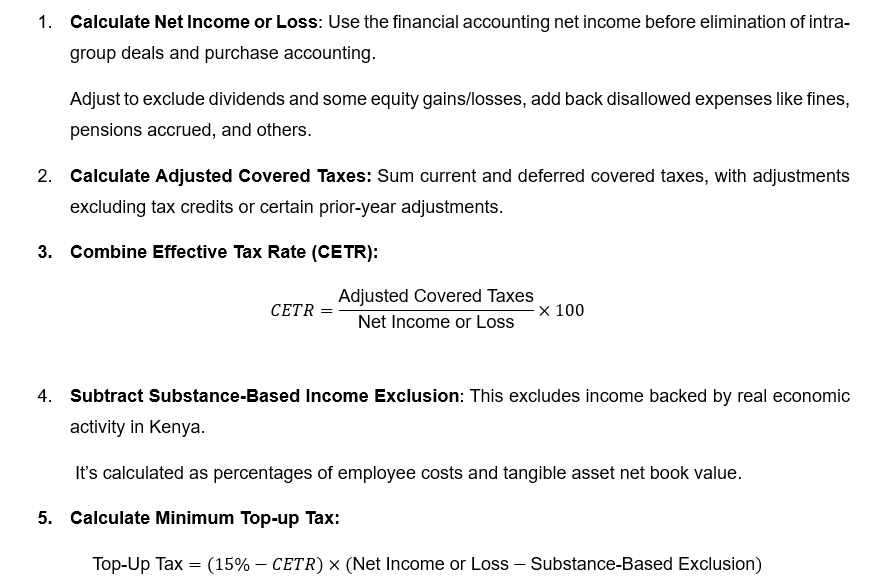
The core rule is simple: you calculate your combined effective tax rate by dividing your adjusted tax paid by your adjusted net income.
If this rate is below 15%, you pay a top-up tax to bring the effective rate up to that figure.
This is aimed at stopping MNEs from legally lowering tax bills through aggressive international tax planning or low-tax havens.
If the rate is above 15%, no additional top up tax is due.
Calculating the Minimum Top-Up Tax
Why this Matters
- The draft regulations ensure that multinationals pay a minimum level of tax in Kenya, reducing incentives for shifting profits offshore.
- This will promote tax compliance transparency via mandatory filings of the minimum top up tax returns and the GloBE information return.
- The minimum top up tax introduces an added layer of tax risk management MNEs that will have to track and report these complex computations.
- The minimum top up tax affects multinational investment and operational decisions, especially for businesses with low effective tax footprints or significant intangibles and financing structures.
Practical Checklist for MNEs
- Check if your turnover hits the €750 million threshold twice in the past 4 years.
- Gather reliable accounting net income data pre-consolidation adjustment.
- Maintain detailed employee cost and tangible asset records.
- Prepare for adjusted covered tax reconciliations, including deferred tax.
- Track deadlines for notification and MTUT/GloBE filing.
- Review intra-group financing for exclusions.
- Anticipate audit risk and ensure proper documentation.
- Coordinate with group entities on allocation and elections.
Multinational enterprises operating in Kenya face a new tax reality. The Minimum Top-Up Tax regulations demand meticulous compliance, precise calculation, and strategic tax planning and navigating this evolving landscape requires more than just compliance it demands expert guidance from advisors who understand both Kenyan specifics and the global landscape.
Intelpoint Consulting stands ready as your trusted partner in this challenge. With deep expertise in international tax, transfer pricing, and Kenyan local tax laws, we help multinationals:
- Interpret and apply the draft regulations accurately to your business model and financials.
- Calculate your combined effective tax rate and minimum top-up tax liabilities with precision.
- Design and document robust substance-based income exclusions to optimise tax outcomes lawfully.
- Prepare compliant tax filings and GloBE information returns.
- Anticipate and manage audit and enforcement risks with thoughtful strategy.
- Leverage international tax planning techniques that align with global minimum tax standards yet safeguard your competitive edge.
Contact us today to map your compliance roadmap, fortify your reporting framework, and unleash tailored international tax strategies that keep your group ahead in this new era of global taxation.
Intelpoint Consulting
info@intelpointconsulting.com
+254 714 348 150
Disclaimer: This alert is for informational purposes only and does not constitute legal or tax advice. Please contact us to discuss your specific circumstances.