
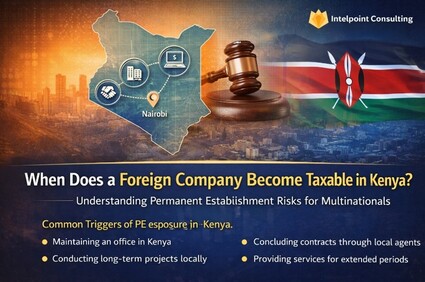
Understanding Permanent Establishment Risks for Multinationals
As international business activity increasingly crosses borders, one of the most critical questions facing foreign investors is whether their activities in a particular country create a taxable presence.
In Kenya, this issue is primarily governed by the concept of a Permanent Establishment (PE). Where a foreign company is considered to have a permanent establishment in Kenya, the profits attributable to that establishment become subject to Kenyan corporate income tax.
Understanding when a permanent establishment arises is therefore essential for multinational enterprises seeking to manage their tax exposure and operate with confidence in the Kenyan market.
The Permanent Establishment Concept: A Cornerstone of International Tax
Under the Kenyan Income Tax Act and most of Kenya’s double taxation agreements, a permanent establishment generally refers to a fixed place of business through which the business of an enterprise is wholly or partly carried on. This definition reflects the traditional international tax framework found in the OECD Model Tax Convention and the UN Model Double Taxation Convention.
Where such a presence exists, Kenya acquires the right to tax the profits attributable to the activities of that permanent establishment within the country.
Common Situations That May Create a Permanent Establishment
In practice, a permanent establishment may arise in several distinct ways. Understanding these categories is the first step in managing your risk profile.
Fixed Place of Business PE
A foreign enterprise may create a permanent establishment where it maintains a physical place of business in Kenya from which commercial activities are conducted.
Examples may include:
- Offices or branches
- Factories or workshops
- Warehouses used for business operations
- Mining or extraction sites
- Construction or installation projects lasting beyond specified time thresholds (typically 6-12 months, depending on the applicable tax treaty)
Even relatively small operational footprints may trigger a permanent establishment where the location is used on a continuous, regular basis for business purposes.
Service Permanent Establishment (Service PE)
In many cases, foreign companies provide services in Kenya without establishing a formal office. However, prolonged service activities may still create a taxable presence under a Service PE provision, which is included in many of Kenya’s tax treaties.
This may occur where:
- Employees or consultants of a foreign enterprise perform services in Kenya
- The services are performed for an extended period—typically exceeding 90 or 183 days within any twelve-month period, depending on the specific treaty
- The services are provided to local clients on a sustained basis
Service PEs are particularly relevant for consulting firms, engineering companies, technology providers, and other professional service businesses whose value lies in the expertise of their people.
Dependent Agent Permanent Establishment
A permanent establishment may also arise where a person in Kenya acts on behalf of a foreign enterprise and has—and habitually exercises—the authority to conclude contracts for that enterprise. In such cases, the local agent effectively functions as an extension of the foreign company’s business, creating a taxable presence even in the absence of a physical office.
Tax authorities will typically examine whether the agent:
- Habitually concludes contracts on behalf of the foreign enterprise
- Plays the principal role in negotiating contracts, even if formal signing occurs overseas
- Is economically dependent on the foreign company and acts exclusively or almost exclusively for it
Where these conditions are met, the foreign enterprise may be considered to have a taxable presence in Kenya.
Signs Your Business May Have Created a Permanent Establishment in Kenya
Your company may face PE exposure if:
- Local representatives negotiate or conclude contracts
- Employees regularly work from Kenya
- Service projects exceed treaty time thresholds
- Local agents act exclusively or almost exclusively for your company
- Revenue is generated from Kenyan customers through digital platforms
Emerging Risks in the Digital Economy
Traditional permanent establishment rules were designed around physical presence. However, modern business models increasingly involve digital platforms, remote work, and cross-border services with no physical footprint.
As a result, several jurisdictions—including Kenya—are introducing new rules that allow taxation where companies maintain a Significant Economic Presence (SEP) without a physical location. Kenya’s tax framework now incorporates Significant Economic Presence (SEP) rules that allow the taxation of income derived from digital services and transactions provided to Kenyan users through digital platforms.
These developments reflect a broader global effort, including work by the OECD/G20 Inclusive Framework on Pillar One, to ensure that profits generated from local markets are appropriately taxed, regardless of physical presence.
Multinational companies providing digital services, cloud computing, online advertising, and social media platforms should therefore carefully evaluate their Kenyan tax exposure under these evolving regulatory frameworks.
Managing Permanent Establishment Risk: Practical Steps for Multinationals
Permanent establishment issues often arise unintentionally when business expansion outpaces tax planning. A local representative begins negotiating contracts, a short-term project extends beyond a treaty threshold, or a dependent agent’s role evolves—and suddenly, an unintended taxable presence is created.
Companies can reduce the risk of an unexpected PE exposure by:
- Clearly defining the roles of local employees, representatives, and agents
- Structuring service delivery arrangements carefully to avoid breaching time thresholds
- Monitoring the duration of projects and service engagements in real time
- Maintaining robust contractual documentation that accurately reflects the agreed business relationship
- Conducting periodic reviews of operational structures against applicable tax treaty provisions
Proactive planning is particularly important where business activities span multiple jurisdictions, as treaty provisions and local interpretations can vary significantly.
Conclusion
Kenya remains one of the most attractive investment destinations in Africa, offering significant opportunities for multinational enterprises. At the same time, companies must carefully navigate their cross-border tax obligations to avoid unintended exposure, penalties, and reputational risk.
Understanding how permanent establishment rules operate—and how they apply to modern, digital business models—is essential for multinational companies operating in or entering the Kenyan market.
Early assessment and proper structuring can significantly reduce the risk of unexpected tax liabilities, providing certainty and peace of mind.
Intelpoint Consulting advises multinational enterprises on permanent establishment risk assessment, cross-border structuring, and international tax compliance across African jurisdictions.
If your organization would like to review its operating structure or assess potential tax exposure in Kenya, contact Intelpoint Consulting for a confidential advisory discussion.